Cost per lead formula: from cost per lead to cost per customer
Cost per lead is your ad spend divided by the number of leads. If you spend €3,000 and get 100 leads, your cost per lead is €30. The number that pays the bills is cost per customer: spend divided by the leads that actually buy.
You can work out both with my free cost per lead calculator. Below I explain the formulas and how to read them.
What is the cost per lead formula?
Cost per lead = ad spend / number of leads
A lead is anyone who left their details. A form, a call, a chat, a booking. Count them the same way every month, or the trend means nothing.
Decide what goes into spend, and keep it fixed. Some people use ad spend only. Others add agency fees and tools. Both work. Mixing them from one month to the next does not.
What is cost per qualified lead?
Not every lead is worth a call back. Some are spam, some are students, some want a job. A qualified lead is one your team checked and wants to follow up.
Cost per qualified lead = ad spend / qualified leads
This number needs one thing the ad platform does not have: a "qualified" stage in your CRM, filled in by the person who called.
How do you calculate cost per customer?
Cost per customer = ad spend / customers from those leads
If you know your rates, you can also work it out from cost per lead:
Cost per customer = cost per lead / (qualified rate x close rate)
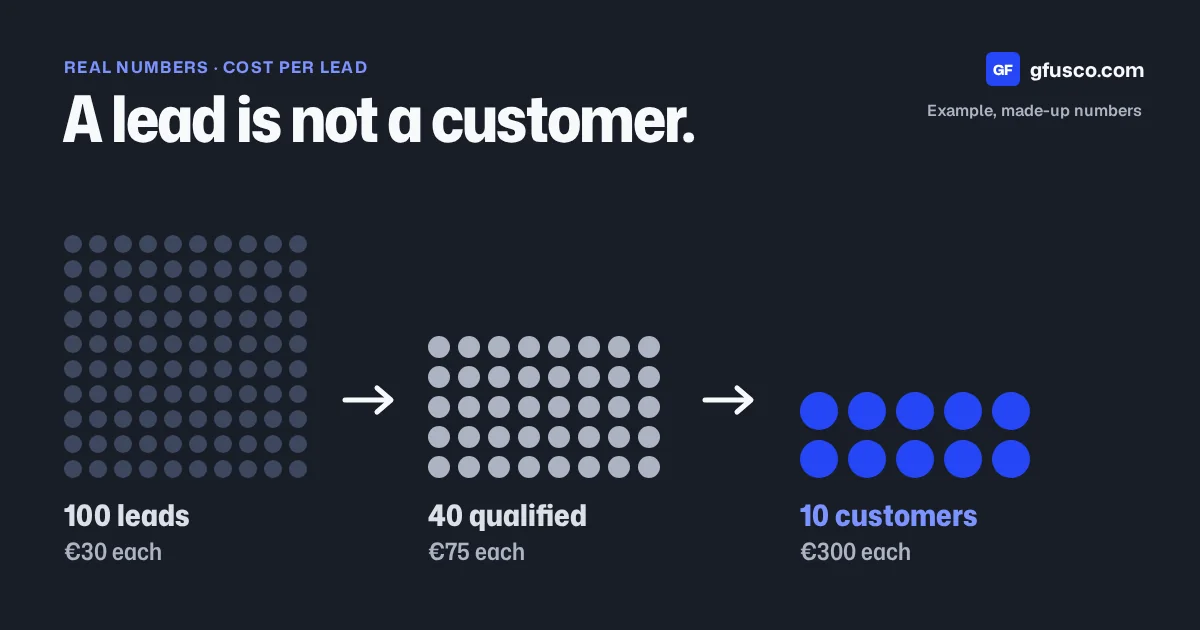
Here is a worked example. These are example numbers, not a real client.
| Step | Example |
|---|---|
| Ad spend | €3,000 |
| Leads | 100 |
| Cost per lead | €30 |
| Qualified rate | 40%, so 40 qualified leads |
| Cost per qualified lead | €75 |
| Close rate on qualified leads | 25%, so 10 customers |
| Cost per customer | €300 |
The same €30 cost per lead can hide a €300 customer or a €3,000 one. It depends on the two rates in the middle.
What is the most you can pay for a lead?
Start from what a customer is worth to you. Take the revenue you expect from a new customer and keep only your margin.
Break-even cost per lead = margin per customer x qualified rate x close rate
In the example, say a new customer brings €2,000 in the first year at a 40% margin. That is €800 of margin. Then €800 x 0.40 x 0.25 = €80. Any cost per lead below €80 still makes money on the first year.
This is the same logic as break-even ROAS for online shops. It turns a vague "leads are expensive" into a clear limit.
Why can a lower cost per lead be worse?
Compare two campaigns. These are example numbers.
| Campaign A | Campaign B | |
|---|---|---|
| Cost per lead | €20 | €45 |
| Qualified rate | 15% | 50% |
| Close rate | 20% | 25% |
| Cost per customer | €667 | €360 |
Campaign A looks better in the ad platform. Campaign B brings customers at about half the price.
This happens all the time with Meta instant forms, broad keywords and automated campaigns. Ad platforms optimise for what you tell them. If you only tell them about leads, they find cheap leads.
What is a good cost per lead?
There is no good cost per lead in general. A €200 lead can be cheap for a company selling €50,000 contracts. A €15 lead can be expensive for a €90 service.
Industry benchmark tables are a weak guide. They mix businesses with very different margins and close rates. Your own break-even cost per lead, from the formula above, is a much better guide.
Where do the qualified and close rates come from?
From your CRM. You need at least three stages: new lead, qualified, won. You also need people to update them.
If you do not have these yet, start now. After a few weeks you will have your own rates. They will be more useful than any benchmark.
Once you have the stages, send them back to the ad platforms. In Google Ads this is offline conversions. In Meta it is the Conversions API for CRM. Then the platforms can look for qualified leads, not just leads.
How do you lower cost per customer?
In my experience the biggest gains rarely come from the ads alone. Look at:
- Response time. Leads called within the hour qualify far more often. See my post on speed to lead.
- Form questions. One or two qualifying questions filter out people who will never buy.
- Feedback to the platforms. Optimising for qualified leads changes who the platforms show your ads to.
- Tracking. If conversions are duplicated or missing, every number above is wrong. Check server-side tracking and Consent Mode v2.
FAQ
What is the difference between cost per lead and cost per acquisition?
Cost per lead counts contacts. Cost per acquisition usually counts customers or sales. For lead generation, cost per acquisition is the same as cost per customer.
Should I include agency fees in cost per lead?
You can. Just stay consistent. For bidding inside the ad platform, use ad spend only. For business decisions, include everything.
Is cost per customer the same as CAC?
Close. Customer acquisition cost often includes all sales and marketing costs, not only ads. Cost per customer from ads is one part of it.
How often should I check these numbers?
Weekly for cost per lead. Monthly for cost per customer, because deals take time to close.