Break-even ROAS: the formula, a worked example and what to target
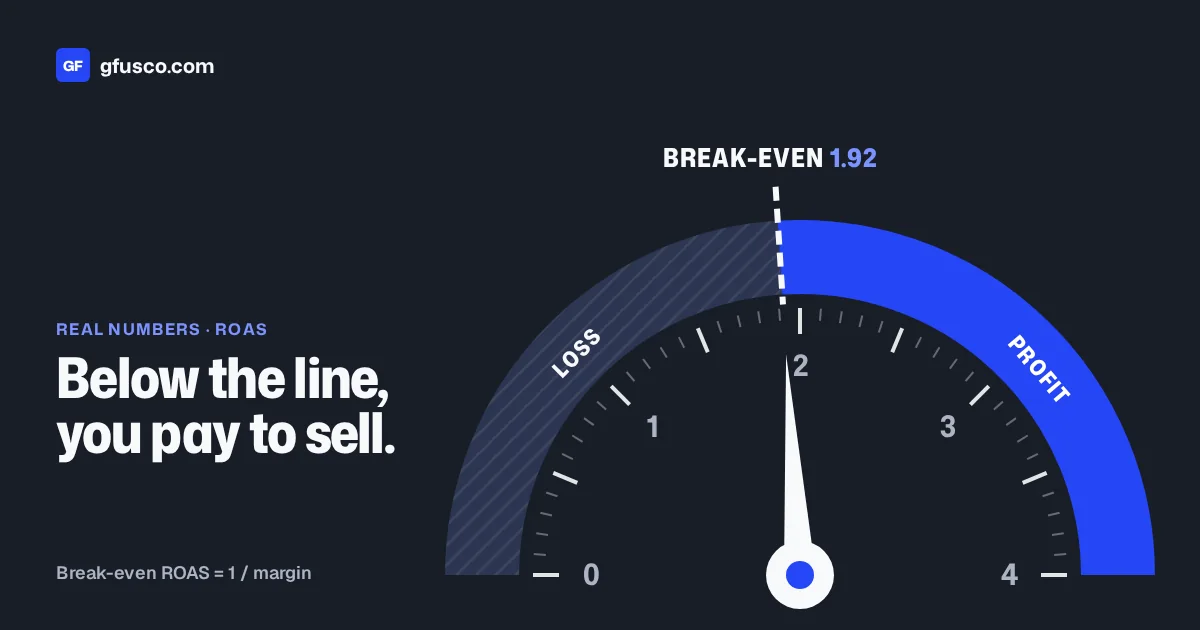
Break-even ROAS is the return on ad spend at which a sale from ads makes you no money and loses you none. You get it by dividing 1 by your contribution margin. If you keep 40% of every sale after product, shipping and fees, your break-even ROAS is 2.5.
Below that number every sale from ads costs you money. Above it you start to earn. You can work out yours in a minute with my break-even ROAS calculator.
What is break-even ROAS?
ROAS is revenue from ads divided by ad spend. A ROAS of 3 means €3 back for every €1 spent.
The problem is that revenue is not profit. A ROAS of 3 can be great for one shop and a loss for another. It depends on how much of each sale you keep.
Break-even ROAS is the line between the two. It is the ROAS where the margin from a sale pays for the ads, and nothing is left.
What is the break-even ROAS formula?
The formula is short.
Break-even ROAS = 1 / contribution margin %
Contribution margin is what is left from one order after the costs that come with that order. Usually these are:
- the cost of the product
- shipping and packaging
- payment fees
- marketplace or app fees per order, if you pay them
Fixed costs like rent or salaries do not go in here. They stay the same whether you sell one order or a hundred. They matter for the business, but not for the break-even of a single sale.
How do you calculate break-even ROAS? A worked example
These are example numbers, not a real client.
| Item | Example value |
|---|---|
| Average order value, VAT excluded | €80.00 |
| Product cost | €28.00 |
| Shipping and packaging | €8.00 |
| Payment fees, 3% | €2.40 |
| Contribution margin per order | €41.60 |
| Contribution margin % | 52% |
| Break-even ROAS | 1 / 0.52 = 1.92 |
So in this example every €1 of ads has to bring back at least €1.92 in revenue. At a ROAS of 1.92 the shop breaks even. At 1.5 it loses money on each ad sale. At 3 it makes money.
The same sum tells you the most you can pay for one sale. Here it is €41.60. That is your break-even CPA.
What ROAS should you target, not just break even on?
Break-even is the floor, not the goal. You also want profit, and you have fixed costs to pay.
A simple way is to decide what share of each sale you want to keep as profit. Then subtract it from the margin before you divide.
Target ROAS = 1 / (contribution margin % - target profit %)
In the example, say you want to keep 10% of the order value as profit. The sum is 1 / (0.52 - 0.10) = 2.38.
That 2.38 is a number you can work with. You can set it as a target ROAS in Google Ads, or check it against what Meta reports.
Does VAT change break-even ROAS?
Yes, and many people miss it. In Italy shop prices include VAT. Often the purchase value sent to Google Ads or Meta includes it too.
Say the platform counts €97.60 for an €80 order with 22% VAT. It then shows a ROAS 22% higher than the real one. Your break-even line on that reported number moves up the same way. In the example it goes from 1.92 to 2.35, because 80 / 41.60 x 1.22 = 2.346.
Check what value your tracking sends. Then compare ROAS with a break-even built on the same value. The calculator has a field for this.
Why is platform ROAS not the same as real ROAS?
Break-even ROAS only helps if the ROAS you compare it to is right. Often it is not.
These are the cases I see most:
- Duplicate purchases. I once found a Shopify store that sent every purchase twice. The ROAS in the ad platform looked far better than reality.
- Returns and cancellations. The platform counts the sale on the day of the order. It does not know the customer sent it back.
- Consent. In Europe, people who refuse cookies are not measured the same way. Google models part of the gap, as its consent mode page explains. My post on Consent Mode v2 covers it.
- Browser limits. Ad blockers and short cookie lifetimes lose events. Server-side tracking recovers part of them.
Before you judge a campaign on ROAS, check the purchases. Put the orders in your shop next to the conversions in the platform for the same week. If they differ a lot, fix the data first.
What if you sell services, not products?
Then the ROAS in the platform is even less useful. A form fill has no real value on the day it arrives.
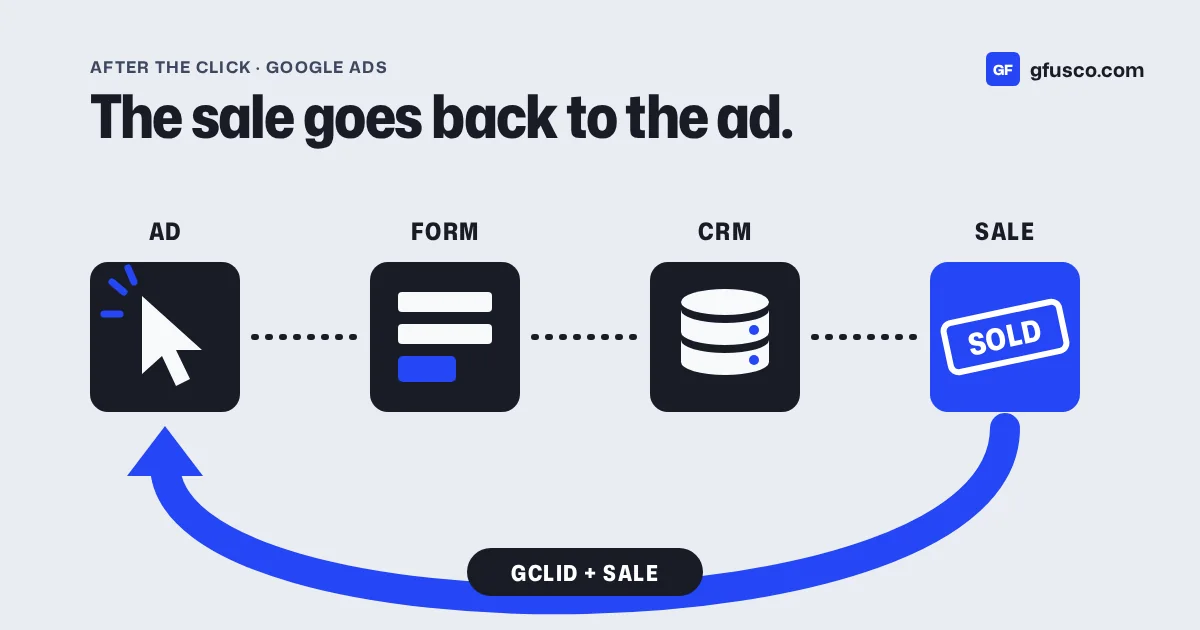
The fix is to measure the sale, not the form. You send closed deals from your CRM back to Google Ads and Meta. I explain how in offline conversions from your CRM. For the cost side, the cost per lead calculator turns cost per lead into cost per customer.
Is a higher ROAS always better?
No. A very high ROAS often means you spend too little. You only reach people who were about to buy anyway, like those searching for your brand name.
If your ROAS sits well above target, try spending more and watch the margin in euros, not only the ratio. A lower ROAS on a bigger budget can leave more money in the bank. What counts is total profit.
FAQ
What is a good ROAS?
There is no single good ROAS. A good ROAS is one above your break-even, with room for profit. With a 25% margin the break-even is 4. With a 60% margin it is 1.67.
Is break-even ROAS the same as minimum ROAS?
Yes. Both mean the lowest ROAS at which ads do not lose money on each sale.
Should I use gross margin or contribution margin?
Use contribution margin if you can. Gross margin often leaves out shipping and payment fees, so the break-even comes out too low.
How do I convert ROAS to ACoS?
ACoS is the inverse of ROAS. A ROAS of 4 is an ACoS of 25%. Your break-even ACoS equals your contribution margin %.