Marketing agency 12-month contract red flags: what to check before you sign
The biggest red flags in a 12-month marketing agency contract are an automatic renewal for another full year, an early exit fee equal to every remaining month, ad accounts created in the agency's name, and no checkpoint before month twelve. Before you sign, get six answers in the contract itself, not in an email. How long it runs and how it renews. How much notice you owe and what leaving early costs. Who owns the ad accounts, data, pixel and domain. What you pay for, with the agency fee kept apart from ad spend. What gets measured and when you decide if it works. What you get back the day after it ends.
A one-year term is not a problem on its own. It becomes one when it removes every way out. I'm a marketing consultant, not a lawyer. This is what I look at when a business owner shows me a contract from their current or next agency. For the legal side, have a lawyer read it before you sign.
Is a 12-month marketing agency contract a red flag?
Not by itself. Some work needs time. SEO and content are slow. A project that starts from nothing, with a site, tracking and campaigns to build, needs a few months before the numbers say anything.
The length is rarely the issue. What sits around it is. In public reviews of Italian agencies I keep reading lines like these, translated: "8 months, zero clients, only a lot of words" and "I keep paying every month and get nothing back". In almost every case the owner found the clauses later, when they wanted to leave.
A fair 12-month contract has three things:
- A reason for the length, in writing. The agency can explain why this work needs twelve months and not three.
- Checkpoints inside the year. At month three and month six you look at numbers you agreed before signing.
- A way out. If the checkpoints go badly, you can leave without paying for months nobody will work.
If all three are missing, the term only protects the agency.
What six questions should you ask before signing?
These are the questions I ask when an owner wants a second opinion on an agency proposal. None of them is about price. You see the price in two seconds. The clauses take longer.
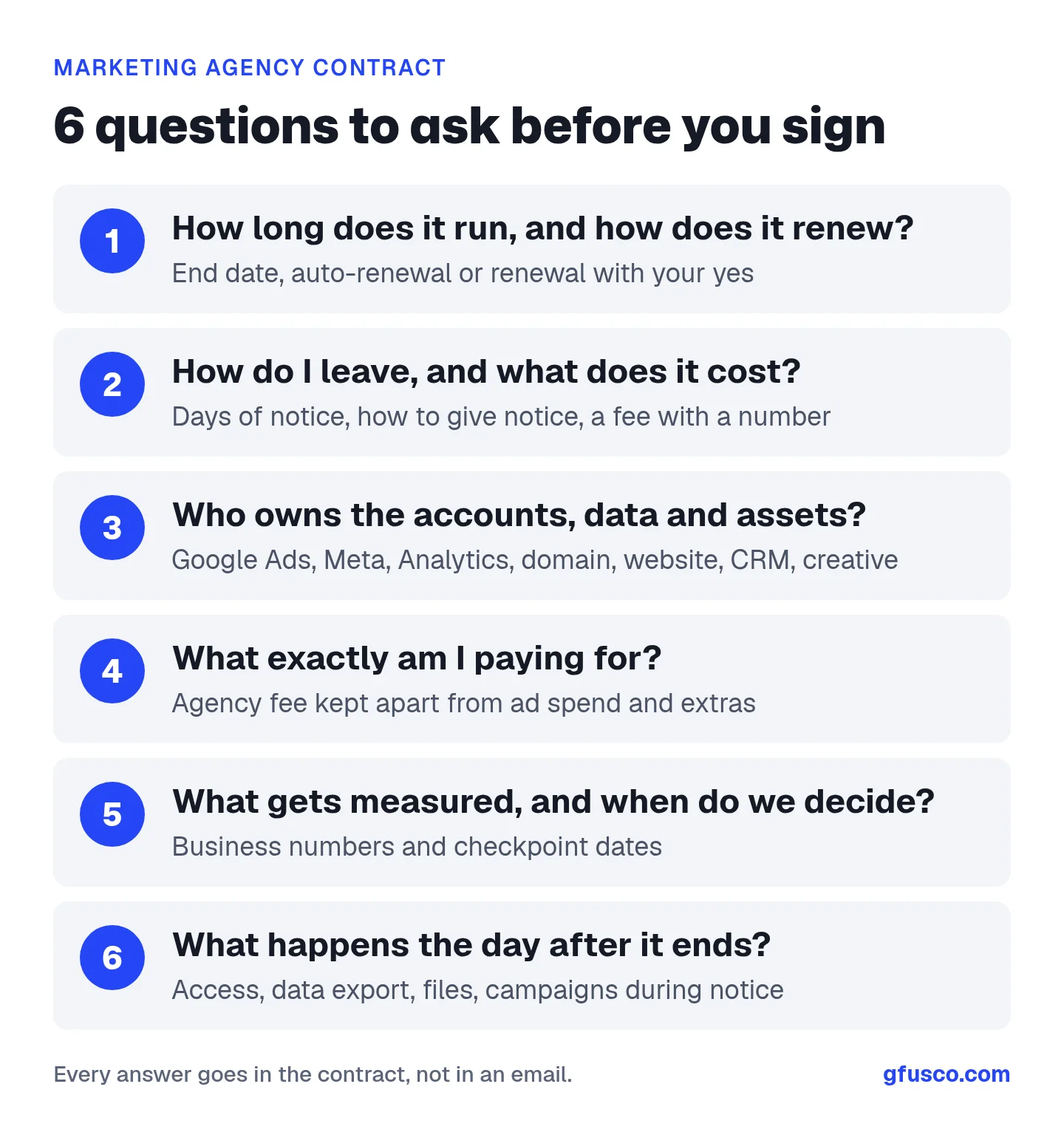
- How long does it run, and how does it renew? Start date, end date, and what happens at the end.
- How do I leave, and what does it cost? Days of notice, how you give notice, and an exit fee with a number on it.
- Who owns the accounts, data and assets? Google Ads, Meta, Analytics, Tag Manager, domain, website, CRM, creative.
- What exactly am I paying for? Agency fee, ad spend, extras and tools.
- What gets measured, and when do we decide? The numbers that matter to your business, and the dates you review them.
- What happens the day after it ends? Access, data export, source files, and the campaigns during the notice period.
Let's go through them one at a time.
How long does the contract really last, and how does it renew?
Search the document for "renew". In many agency terms you'll find a sentence like this one. At the end of the term the agreement renews for another twelve months on the same terms, unless either party cancels in writing at least 60 days before the end date.
It looks harmless. In practice the contract doesn't last a year. It lasts a year, plus every year you miss a date.
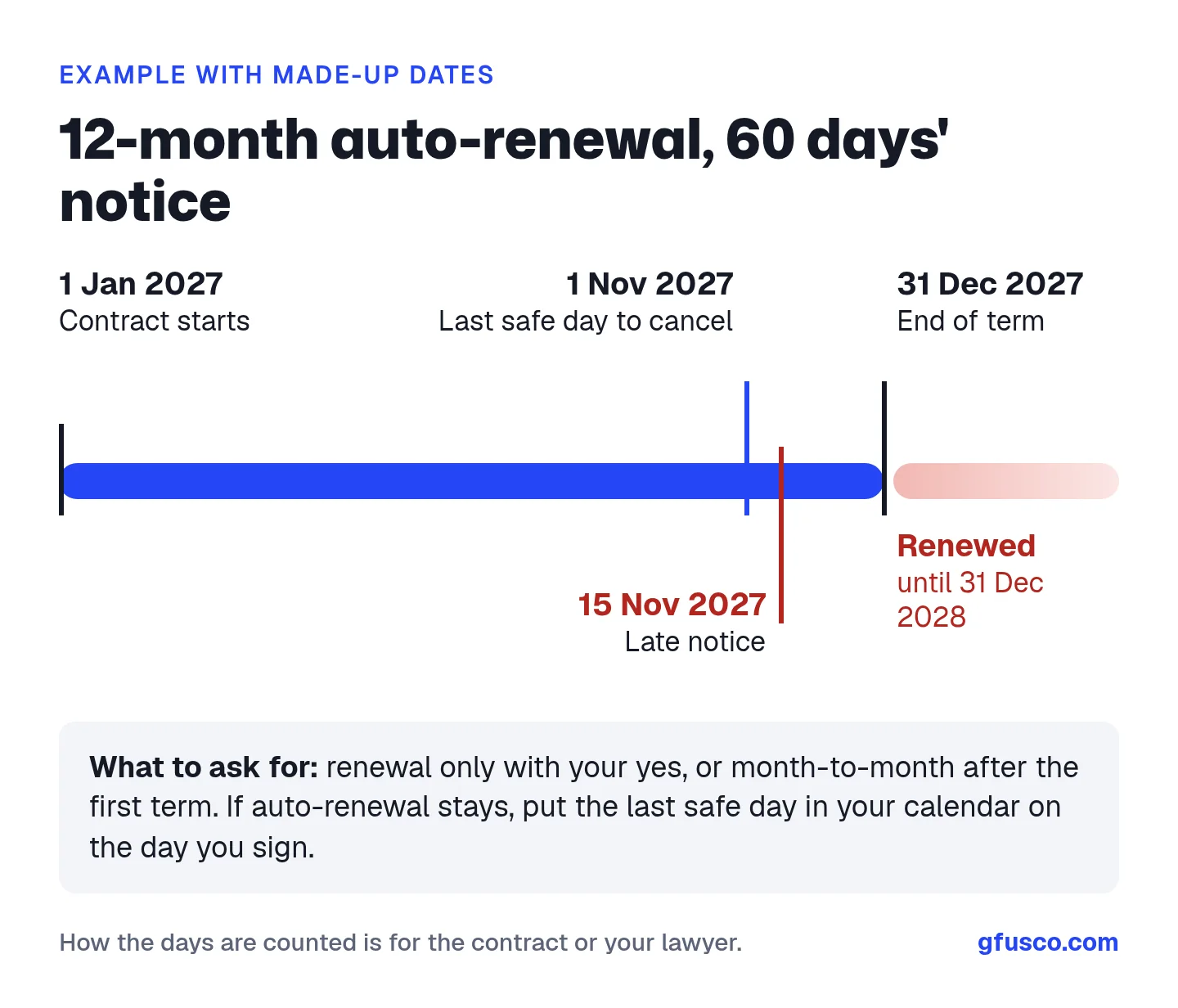
Example with made-up dates. You sign a contract from 1 January to 31 December 2027, with a 12-month auto-renewal and 60 days' notice. Your last safe day to cancel is around 1 November 2027. If your notice goes out on 15 November, you're already renewed until 31 December 2028. How the days are counted, and whether the sending date or the receipt date counts, is for the contract or your lawyer to say.
What to ask for before you sign:
- Renewal only with your yes. At the end of the term you talk and decide. A good agency isn't afraid of that conversation.
- Or month-to-month after the first term. The contract keeps going, but you can end it with one month's notice.
- If auto-renewal stays, a date in your calendar. On the day you sign, set a reminder for the last safe day and another one two weeks earlier.
- How notice must be given. Email, registered letter, a specific address. Write down which one and from when it counts.
How much notice do you owe, and what does leaving early cost?
There are two different clauses here. Read both.
The notice period. Thirty days on a monthly retainer is normal. Sixty is livable. Ninety days on a monthly fee means paying three months for a relationship that's already over. Also check when the clock starts: on the day you give notice, or at the end of that month.
The early exit fee. Some agency terms don't let the client end the contract early at all. If you stop, every remaining monthly payment falls due at once. That clause turns a one-year contract into a one-year debt.
Example with made-up numbers. A fee of 500 a month for twelve months. In month four you see no results and want out. With an exit fee equal to the remaining payments, you owe eight months, so 4,000, for work that will never be done. With 30 days' notice and no exit fee, you owe one month.
What to ask for:
- An exit fee with a figure or a formula, not open-ended "damages".
- A free exit if the agreed checkpoints are missed.
- The same right to end the contract for you and for the agency.
- In writing, from the salesperson: what you would owe if you left in month three.
Some terms ask you to sign a second time to approve specific clauses, often the ones on renewal, termination and fees. If you're asked to sign twice, read what the second signature approves. Whether those clauses hold up is a question for your lawyer, not for me.
Who owns the ad accounts, data, pixel and domain?
This is the question that costs the most when you find out late. Campaign history, conversions, audiences and the data Google and Meta use to optimise all live inside the accounts. If the accounts belong to the agency, you start from zero when you leave.
The rule is simple. Accounts are created in your company's name, and the agency gets access that you can remove.
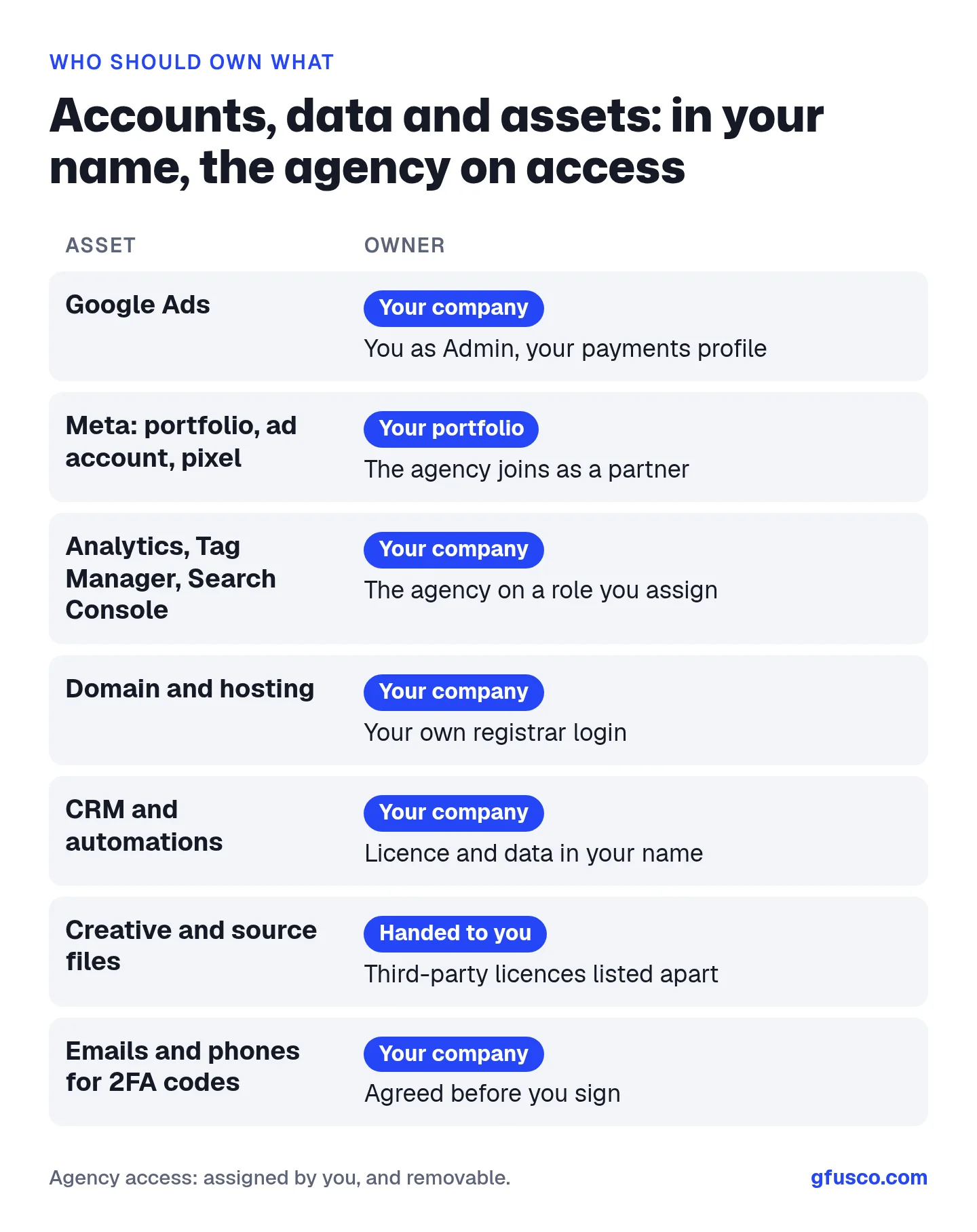
- Google Ads. At least one person from your company with Admin access, on a company email address. Only Admin users can add or remove users and unlink the agency's manager account (access levels). If the agency created your account from its manager account, it shows as the owner, but the client account can always unlink (Google Ads Help on ownership). The payments profile should be your company's.
- Meta. Your business portfolio holds the ad account, the Page and the pixel. The agency joins as a partner. According to Meta's help page on adding ad accounts to a business portfolio, an ad account created in a portfolio stays in that portfolio and can't be transferred. If the agency creates it in its own portfolio, it will never be yours.
- Google Analytics, Tag Manager, Search Console, Merchant Center. Created with a company account, with the agency on a role you assign.
- Domain and hosting. Registered to your company, with your own login to the registrar.
- CRM and automations. The CRM is your customer list. The licence and the data should be yours.
- Creative, copy, source files. The contract says what is handed over to you and what stays licensed, like stock photos and music.
One detail almost no contract covers: who gets the two-step verification codes. It happened to me on a B2B account. To get into the tools that send conversions from the CRM back to Google Ads, we needed a code that went to the client's inbox. That was fine, because the accounts were theirs. But we had to book a time with someone on their side. Decide before you sign which emails and phone numbers receive those codes, and make sure they belong to your company.
If you already work with an agency, how to check if your Google Ads agency is any good shows how to check this access in about an hour.
What are you paying for: fee, ad spend and extras?
A clear proposal has at least three separate lines:
- The agency fee. A fixed monthly fee, a project price, or a percentage of ad spend.
- Ad spend. The money that goes to Google and Meta. Ideally you pay it directly, with your own payment method on each platform.
- Extras. Tools, licences, photos, video, website work, anything outside the agreed scope.
A percentage-of-spend fee isn't wrong, but remember how it works. When spend goes up, the fee goes up. Ask what happens if you suggest cutting the budget on a campaign that doesn't pay back.
If the agency buys Google Ads for you and sends one invoice, the Google third-party policy asks for some specific things. The agency must give you the customer ID of your Google Ads account when you ask for it. Where a monthly report is required, it has to show costs, clicks and impressions for the account, with the exact amount Google charged, without the agency's fees. Google also lists reporting higher costs than Google charged, and moving budget meant for Google Ads to other channels, as untrustworthy behavior.
Put it in the contract: you can see ad spend line by line in the platforms, not only on an invoice.
To work out what you can afford to pay per lead before you talk contracts, use the free cost per lead calculator. For an online store there's the break-even ROAS calculator.
What gets measured, and when do you decide if it works?
Many contracts list activity. Posts published, hours worked, keywords tracked, reports sent. Activity matters, but it doesn't tell you if the work pays. Ask for the numbers that matter to your business in the contract or in an appendix.
- For service businesses: qualified leads, booked appointments, cost per customer. Not form fills.
- For online stores: sales, margin, cost per order. Not the conversions a platform gives itself credit for.
- Where the numbers come from: your CRM, your order system, your store dashboard. If a number only comes from the ad platform, the one being checked is doing the checking.
Then the dates. A checkpoint in month one to confirm tracking counts the right things. One in month three for the first real numbers. One in month six to decide if you carry on. If tracking is wrong, every number after it is wrong too. I wrote about this in why Google Ads, GA4 and CRM numbers don't match and in why Performance Max brings junk leads.
Be careful with guarantees. Google's policy doesn't allow third parties that manage Google Ads to guarantee top ad placement, because position is set by an auction on every search. A serious commitment is about the work and the response times. Results get measured and discussed.
Who actually works on your account, and what do you see each month?
In the pitch you talk to the founder or the salesperson. After you sign, someone else runs the account, sometimes a freelancer. That isn't bad by itself. It's bad if nobody tells you.
- Ask for the name of the person who will run the account, and what happens if they leave.
- Ask how many hours or which tasks are included each month, and how you'll see them.
- Ask for a report that says why the numbers moved and what happens next month, not just charts.
- Keep direct access to the accounts. The Google Ads change history shows who changed what, and when.
If the agency lets Google auto-apply recommendations, ask for that in writing so you know. I explained how to check it in how to turn off auto-apply recommendations.
What happens the day after you cancel?
This is the part almost nobody reads, and it's where the ugliest exits come from. Recently a business that was thinking about changing providers asked me where to start. The first list wasn't about campaigns. It was about who owns the ad accounts and the domain, how many days of notice they owed, and how to export the data. Without those three answers we couldn't plan anything.
A good exit clause says the agency will:
- Hand over Admin access to every account it created for you, within a set number of days.
- Export the data it keeps in its own tools, like lead lists, call recordings and reports, in a format you can use.
- Keep campaigns running, unchanged, during the notice period unless you ask otherwise.
- Not pause, delete or restructure anything during the handover.
- Hand over the source files, copy and creative that belong to you.
If the agency handles personal data for you, such as form leads or customer lists uploaded to the ad platforms, and you are in the EU, Article 28 of the GDPR requires a contract or other legal act. Among other things it must say that when the service ends, the agency deletes or returns the personal data, at your choice. How to write that for your case is your lawyer's call.
Which clauses are red flags, and what does a fair version look like?
I keep this table as a reminder. One item on the left doesn't prove an agency is bad. Two or three together deserve a conversation before you sign.
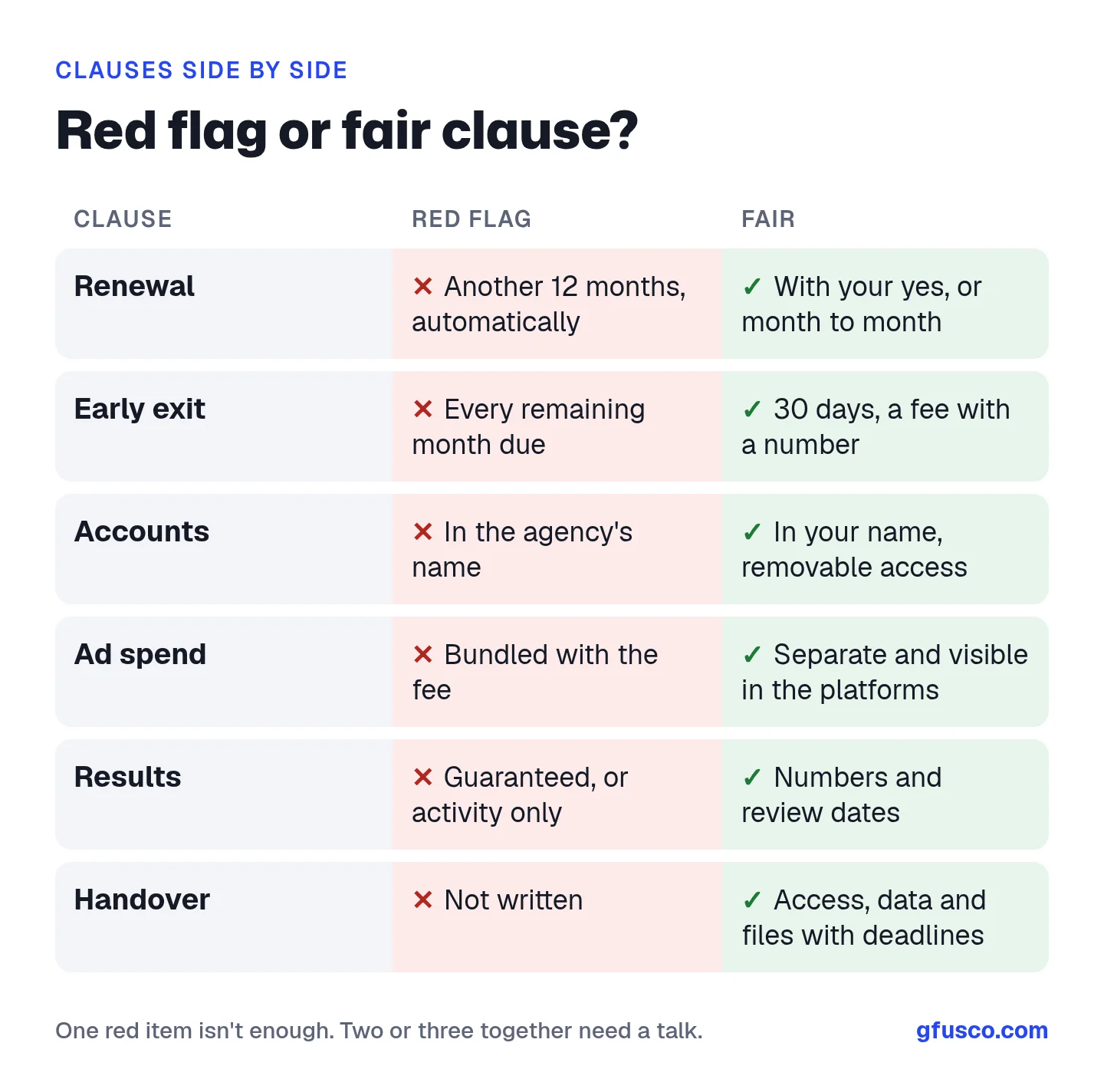
| Clause | Red flag | Fair version |
|---|---|---|
| Renewal | Renews for another 12 months unless you cancel 60 or 90 days before | Renews only with your yes, or month-to-month after the first term |
| Early exit | Not allowed, or every remaining month falls due | 30 days' notice, a fee with a number, a free exit if checkpoints are missed |
| Accounts | Created by the agency, in its name | In your name, the agency on access you can remove |
| Ad spend | Bundled with the fee in one figure | Separate, paid by you to the platforms or reported to the cent |
| Results | Guaranteed, or only a list of activities | Agreed business numbers and dates to review them |
| Handover | Not written down | Access, data, files and unchanged campaigns during notice, with deadlines |
How do you read an agency contract in 30 minutes?
You don't need to read every line with the same care. This is the order I follow.
- Find the term and the word "renew". Write down the end date, the renewal length and the days of notice.
- Find "termination" and "fee". Work out what you would pay if you left in month three. If you can't, ask in writing.
- Find who owns the accounts. Google Ads, Meta, Analytics, Tag Manager, domain, website, CRM. If the contract is silent, add a line.
- Split the costs. Fee, ad spend, extras. Check who pays the platforms and with which payment method.
- Find what gets measured. If you only see activities, ask for an appendix with the numbers and the checkpoint dates.
- Read what happens at the end. Access, data export, files, campaigns during the notice period.
- Look at the signatures. If a second signature approves specific clauses, read those clauses again.
- Send it to your lawyer. With your notes, so they know where to look.
If an answer only lives in the salesperson's email, it doesn't exist for the contract. Ask for it to be written in.
Why I work without a minimum term
I'll say it, since I'm writing about contracts. I work with no minimum term, and clients can cancel month to month. Ad accounts, data and tracking stay in the client's name from day one. If you stop, everything stays with you.
It isn't the only fair way to work. An agency with a large team and long projects can have good reasons to ask for more time. It works for me because the first month is about understanding the business and fixing the numbers. After that, if the work isn't useful, it's better to know early.
Frequently asked questions
Is it normal for a marketing agency to ask for a 12-month contract?
Yes, it's common, especially for SEO and content. It's fine if the agency explains why the work needs that long, if there are checkpoints during the year, and if you can leave when those checkpoints are missed. Without those three things the term only protects the agency.
How much notice is reasonable to cancel an agency contract?
For monthly campaign management, 30 days is normal. Sixty is livable. Ninety days on a monthly fee is a lot, because you pay three months for a relationship that is already over. Also check when the notice period starts.
Can I get my Google Ads account back if the agency created it?
Often, yes. If you have Admin access on the account, you can unlink the agency's manager account and keep the history and conversions. If you have no access at all, ask for it in writing before you cancel. Meta works differently: an ad account created in the agency's business portfolio stays there and can only be shared.
Can an agency guarantee results or the top spot on Google?
Not the top ad position. Google's third-party policy doesn't allow it, because position is decided on every search. For results, you can agree on numbers and review dates, with a way out if they don't arrive. That's more useful than a guarantee.
Should a lawyer read my marketing agency contract?
Yes, for the legal parts like exit fees, renewal, termination and personal data. This article helps you know what to ask for on the marketing and operations side. A lawyer tells you what holds and how to word it.
What should I do if I already signed?
First, put the last safe day to cancel in your calendar. Then check who owns the accounts and ask for Admin access if you don't have it. Finally, ask for the numbers that matter to you and a date to review them together.
Sources
- Google third-party policy, Google Ads Advertising Policies Help
- Harassing, abusive, or untrustworthy behavior, Google Ads Advertising Policies Help
- About access levels in your Google Ads account, Google Ads Help
- About manager account ownership of client accounts, Google Ads Help
- Find your Google Ads customer ID, Google Ads Help
- Add an ad account to your business portfolio, Meta Business Help Center
- Give a partner access to business assets, Meta Business Help Center
- Regulation (EU) 2016/679 (GDPR), Article 28, EUR-Lex